100% vegan, non - toxic, and sterilized
Trusted by numerous artists
Step into any tattoo studio, flip through any tattoo portfolio, and your gaze can never avoid one color—black.
It outlines contours, defines shadows, bears weight, and sometimes even completes an entire grand narrative alone. It is everywhere, to the point where we almost forget to ask: why?
In a spectrum filled with countless vibrant hues, why does black tattoo ink remain the most indispensable and heavily used presence on every artist’s workstation? Today, let’s momentarily set aside the colorful palette and dive into the depth of black, exploring its eternal code as the soul color of the tattoo world.
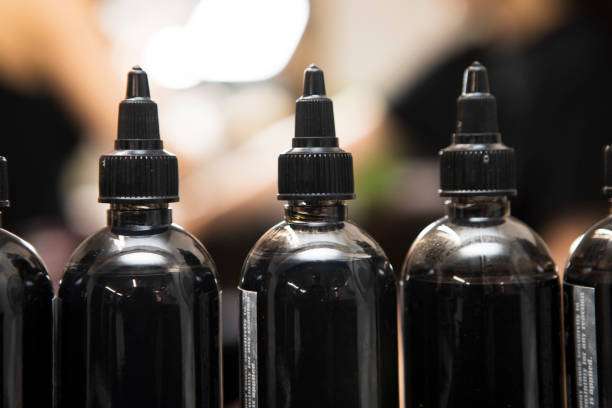
Black is first and foremost a statement. Across human culture, it carries complex and multi-layered symbolism.
In many Western traditions, black is associated with solemnity, authority, and power (think judge’s robes or classic evening wear). It signifies endings, yet also beginnings (the darkness before the Big Bang).
In tattooing, particularly in old school and Japanese traditional (Irezumi) styles, deep, solid black outlines are foundational. These clear, decisive lines are not just a technical requirement but an aesthetic declaration: they symbolize the permanence of the piece, the solidity of its structure, and a commitment that withstands the test of time.
Black also conveys mystery, the unknown, and introspection. A geometric pattern composed purely of dotwork or shading, or a carefully filled blackwork area, creates depth and meditative space.
It does not shout, yet it commands visual attention, drawing viewers to subtle shifts in texture and shadow.
Furthermore, black is linked with mourning, rebellion, and counterculture. From sailors memorializing comrades in black tattoos to the expression of dissent and identity in punk and goth subcultures, it has long been a silent but powerful language.
Stripped of cultural symbolism, from a purely technical standpoint, black tattoo ink is the skeleton and flesh of all visual imagery.
Whether fine single-needle lines or bold traditional outlines, black ink defines boundaries. A smooth, sharp, saturated black line breathes life and clarity into the tattoo. Like steel in architecture, it supports the structure.
The quality of lines—uniformity, solidity, edge clarity—directly affects professionalism and longevity. Therefore, black ink for lining demands extremely fine pigment particles, pure concentration, and stable flow.
Without shading, images are flat. Black ink, through different dilutions and techniques such as shading, creates countless tones from deep gray to light gray. These shadows provide three-dimensionality, soft volume, and emotional depth.
A clever gray transition can make petals tender, muscles powerful, and eyes soulful. Shadowing with black requires excellent spread and blending, ensuring smooth transitions without clumping or patchiness.
Large areas of solid black are the ultimate source of visual impact. They create strong negative space, contrasting sharply with skin, making adjacent colors or blank areas pop.
A “good” solid black should resemble deep velvet—even, profound, absorbent, and without any impurity or gray haze. This tests the ink’s pigment density and coverage to the extreme.
Understanding black’s dual mission—cultural and technical—we see that professional black tattoo ink is far more than “just black.” It is one of the craftsman’s most important tools.
First, it must have ultimate depth and purity. This comes from high-concentration, premium pigments. When applied, it should appear dense, solid carbon black, not bluish, greenish, or murky gray. This purity is the foundation of color performance, ensuring fewer impurities and better biocompatibility.
Next, texture is crucial. Excellent black ink should have a smooth and stable flow, allowing the artist to perform precise lines or evenly lay large shadow areas. It flows effortlessly from the needle, blends naturally with skin, reduces repeated friction, and aids healing.
Longevity is its soul. Tattoos last over time. Optimized black ink has exceptional color retention, staying firmly in the dermis, resisting metabolism and UV exposure, preserving clarity and depth, and minimizing fading.
Finally, safety is non-negotiable. Any skin-applied ink, especially foundational black, must be produced in strict sterile conditions, ensuring each bottle is disinfected. Using a 100% vegan formula (no animal-based components like traditional bone black) is now the modern professional standard, providing purity and ethical reliability.
A bottle meeting all these criteria is a silent, reliable partner. It allows the artist to fully trust its performance and focus entirely on creation, exploring the limitless possibilities of black—from intricate Gothic designs to minimalist lines.
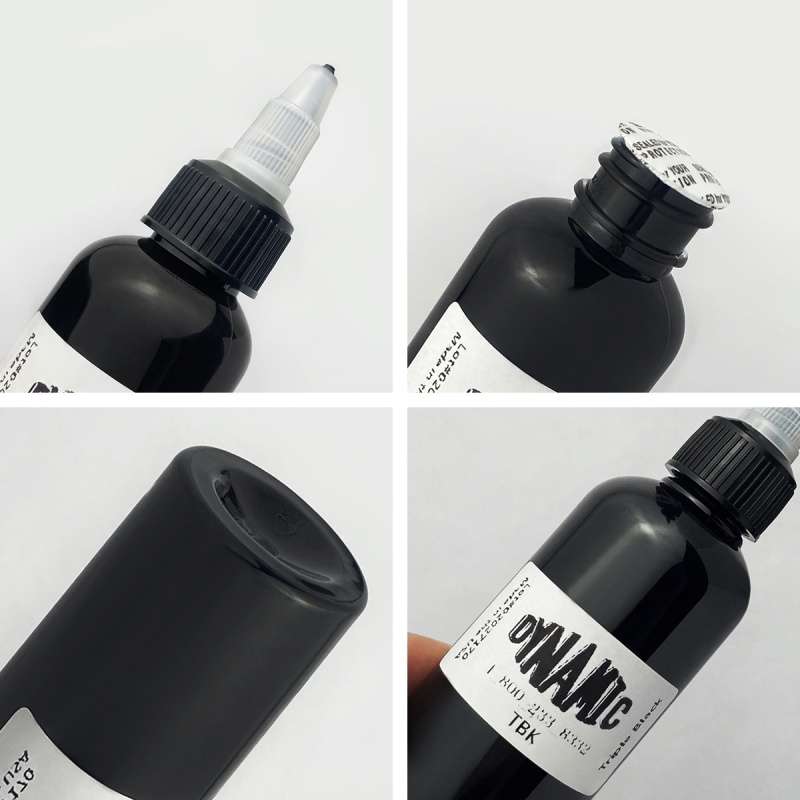
Today, black tattoo ink is continually being reinvented. It is no longer just a secondary tool for outlines and shading.
Monochromatic black-and-gray realism utilizes black layers to the extreme, creating photo-level detail and emotion with only black, white, and gray. Abstract black geometric patterns explore form and skin space using solid fills, lines, and dotwork.
Even in colored tattoos, high-quality black as a background or contrast makes adjacent colors appear brighter and more vivid.
Black is both the starting point and the finish. It is constraint and freedom. It is the simplest color with the most complex expression.
A: Generally, high-quality carbon-based black tattoo ink is chemically stable and least likely to trigger reactions. Carbon is inert and not easily broken down or metabolized by the body.
The key to safety lies in ink purity and sterile production, not the color itself. Choosing reputable professional vegan black ink maximizes safety.
A: Several factors may contribute. In rare cases, impure pigments in low-quality ink cause off-tones. More commonly:
Technique: ink inserted too deep into subcutaneous fat can appear bluish.
Skin: personal skin tone (especially pale or yellowish) affects the optical perception of black.
Natural fading: all tattoos soften subtly over time, and minor impurities in low-quality black ink may become noticeable.
High-quality, high-concentration black ink maintains true black for longer and delays visual shifts.

Black is not merely an “unfinished color” or the frame of color. It is history, structure, emotion, and power itself. The black ink silently standing in the studio corner carries the weight of transforming fleeting inspiration into eternal marks. In the world of tattooing, black is never absent; it is proof of all existence. Its deep silence tells the loudest story.
No account yet?
Create an Account